2015/12/02
week twelve
- Dionysia : The Dionysia was a large festival in ancient Athens in honor of the god Dionysus, the central events of which were the theatrical performances of dramatic tragedies and, from 487 BC, comedies. It was the second-most important festival after the Panathenaia. The Dionysia actually consisted of two related festivals, the Rural Dionysia and the City Dionysia, which took place in different parts of the year. They were also an essential part of the Dionysian Mysteries.
- Deus ex mechina : Deus ex machina is a Latin calque from Greek ἀπὸ μηχανῆς θεός , meaning "god from the machine". The term has evolved to mean a plot device whereby a seemingly unsolvable problem is suddenly and abruptly resolved by the contrived and unexpected intervention of some new event, character, ability or object. Depending on how it is done, it can be intended to move the story forward when the writer has "painted himself into a corner" and sees no other way out, to surprise the audience, to bring the tale to a happy ending, or as a comedic device.The term was coined from the conventions of Greek tragedy, where a machine is used to bring actors playing gods onto the stage.
-

- Medea : In Greek mythology, Medea is a sorceress who was the daughter of King Aeëtes of Colchis, niece of Circe, granddaughter of the sun god Helios, and later wife to the hero Jason, with whom she had two children, Mermeros and Pheres. In Euripides's play Medea, Jason leaves Medea when Creon, king of Corinth, offers him his daughter, Glauce.The play tells of Medea avenging her husband's betrayal by killing their children.

- Colchis : In Greco-Roman geography, Colchis was the name for a region in the Southern Caucasus. Colchis was located on the eastern coast of the Black Sea, centered on present-day western Georgia. Around the 1st centuries BC and AD the land south of the Greater Caucasus and north of the Lesser Caucasus was divided between Kolchis in the west, Caucasian Iberia in the center and Caucasian Albania in the east. To the southwest was Armenia and to the southeast Atropatene.
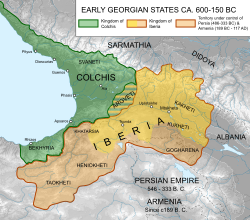
- Golden fleece : In Greek mythology, the Golden Fleece is the fleece of the gold-hair winged ram, which was held in Colchis. The fleece is a symbol of authority and kingship. It figures in the tale of the hero Jason and his band of Argonauts, who set out on a quest for the fleece by order of King Pelias, in order to place Jason rightfully on the throne of Iolcus in Thessaly. Through the help of Medea, they acquire the Golden Fleece. The story is of great antiquity and was current in the time of Homer (eighth century BC). It survives in various forms, among which the details vary.
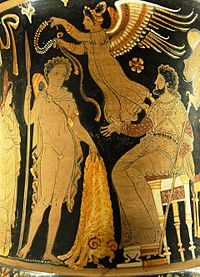
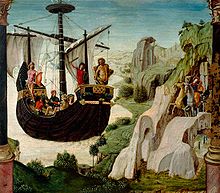
- Argo : In Greek mythology, Argo was the ship on which Jason and the Argonauts sailed from Iolcos to retrieve the Golden Fleece. She was named after her builder, Argus.Argo was constructed by the shipwright Argus, and its crew were specially protected by the goddess Hera. The best source for the myth is the Argonautica by Apollonius Rhodius. According to a variety of sources of the legend, Argo was said to have been planned or constructed with the help of Athena. According to other legends she contained in her prow a magical piece of timber from the sacred forest of Dodona, which could speak and render prophecies. After the successful journey, Argo was consecrated to Poseidon in the Isthmus of Corinth. She was then translated into the sky and turned into the constellation of Argo Navis.
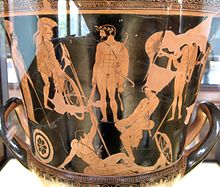
- Argonaut : The Argonauts were a band of heroes in Greek mythology, who in the years before the Trojan War, around 1300 B.CE, accompanied Jason to Colchis in his quest to find the Golden Fleece. Their name comes from their ship, Argo, named after its builder, Argus. "Argonauts" literally means "Argo sailors". They were sometimes called Minyans, after a prehistoric tribe in the area.
- Chorus : A Greek chorus is a homogeneous, non-individualised group of performers in the plays of classical Greece, who comment with a collective voice on the dramatic action.[1] The chorus consisted of between 12 and 50 players, who variously danced, sang or spoke their lines in unison and sometimes wore masks.
- heroine 女英雄
- Fido Dido :

- Aristophanes : Aristophanes, son of Philippus, of the deme Cydathenaeum, was a comic playwright of ancient Athens. Eleven of his thirty plays survive virtually complete. These, together with fragments of some of his other plays, provide the only real examples of a genre of comic drama known as Old Comedy, and they are used to define the genre.


沒有留言:
張貼留言