Week eleven
Drama - is the specific mode of narrative, typically fictional, represented in performance.The structure of dramatic texts, unlike other forms of literature, is directly influenced by this collaborative production and collective reception. The early modern tragedy Hamlet (1601) by Shakespeare and the classical Athenian tragedy Oedipus the King (c. 429 BC) by Sophocles are among the masterpieces of the art of drama.A modern example is Long Day's Journey into Night (1956) by Eugene O’Neill. Drama is often combined with music and dance: the drama in opera is generally sung throughout; musicals generally include both spoken dialogue and songs; and some forms of drama have incidental music or musical accompaniment underscoring the dialogue

Dionysus - Dionysus is the god of the grape harvest, wine making and wine, of ritual madness, fertility, theater and religious ecstasy in Greek mythology. Alcohol, especially wine, played an important role in Greek culture with Dionysus being an important reason for this life style.He is a major, popular figure of Greek mythology and religion, and is included in some lists of the twelve Olympians. Dionysus was the last god to be accepted into Mt. Olympus. He was the youngest and the only one to have a mortal mother.His festivals were the driving force behind the development of Greek theater. Modern scholarship categorises him as a dying-and-rising god.

Semele - Semele, in Greek mythology, daughter of the Boeotian hero Cadmus and Harmonia, was the mortal mother of Dionysus by Zeus in one of his many origin myths.

Athena - Athena or Athene, often given the epithet Pallas, is the goddess of wisdom, courage, inspiration, civilization, law and justice, mathematics, strength, war strategy, the arts, crafts, and skill in ancient Greek religion and mythology. Minerva is the Roman goddess identified with Athena.Athena is known for her calm temperament.
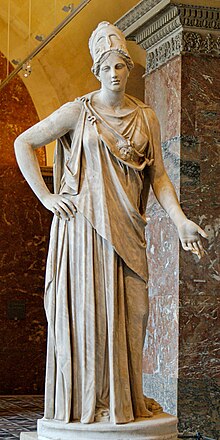
Thespis - Thespis of Icaria (present-day Dionysos, Greece), according to certain Ancient Greek sources and especially Aristotle, was the first person ever to appear on stage as an actor playing a character in a play (instead of speaking as him or herself). In other sources, he is said to have introduced the first principal actor in addition to the chorus.Thespis was a singer of dithyrambs (songs about stories from mythology with choric refrains). He is credited with introducing a new style in which one singer or actor performed the words of individual characters in the stories, distinguishing between the characters with the aid of different masks.This new style was called tragedy, and Thespis was the most popular exponent of it.

The Chorus (French: Les Choristes) - is a 2004 German-Swiss-French drama film directed by Christophe Barratier. Co-written by Barratier and Philippe Lopes-Curval (fr), it is an adaptation of the 1945 film A Cage of Nightingales (La Cage aux rossignols).The plot involves the widely successful orchestra conductor Pierre Morhange (Jacques Perrin), who returns to France when his mother dies. He reminisces about his childhood inspirations when he and his former classmate Pépinot (Didier Flamand) read the diary of their old music teacher Clément Mathieu (Gérard Jugnot). In 1949, a young Morhange is the badly behaved son of single mother Violette (Marie Bunel). He attends the boarding institution for "difficult" boys, Fond de L'Étang ("Bottom of the Pond"), presided over by strict headmaster Mr Rachin (François Berléand). New teacher Mathieu brightens up the school and assembles a choir, leading to the discovery of Morhange's musical and physical talents and a transformation in the children. At the 77th Academy Awards, The Chorus was nominated for Best Foreign Language Film and Best Original Song (the latter for "Vois sur ton chemin", listed as "Look to Your Path").

dithyramb - The dithyramb was an ancient Greek hymn sung and danced in honor of Dionysus, the god of wine and fertility; the term was also used as an epithet of the god: Plato, in The Laws, while discussing various kinds of music mentions "the birth of Dionysos, called, I think, the dithyramb." Plato also remarks in the Republic that dithyrambs are the clearest example of poetry in which the poet is the only speaker.
Aeschylus - Aeschylus was an ancient Greek tragedian. He is also the first whose plays still survive; the others are Sophocles and Euripides. He is often described as the father of tragedy: critics and scholars' knowledge of the genre begins with his work, and understanding of earlier tragedies is largely based on inferences from his surviving plays. According to Aristotle, he expanded the number of characters in plays to allow conflict among them whereas characters previously had interacted only with the chorus.
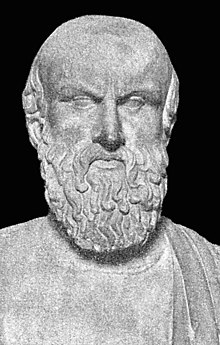
Peloponnesian War - The Peloponnesian War (431–404 BC) was an ancient Greek war fought by Athens and its empire against the Peloponnesian League led by Sparta. Historians have traditionally divided the war into three phases.The Peloponnesian War reshaped the ancient Greek world. On the level of international relations, Athens, the strongest city-state in Greece prior to the war's beginning, was reduced to a state of near-complete subjection, while Sparta became established as the leading power of Greece. The Peloponnesian War marked the dramatic end to the fifth century BC and the golden age of Greece.

Catharsis - Catharsis is the purification and purgation of emotions—especially pity and fear—through art or any extreme change in emotion that results in renewal and restoration. It is a metaphor originally used by Aristotle in the Poetics, comparing the effects of tragedy on the mind of spectator to the effect of a cathartic on the body.

沒有留言:
張貼留言