week fourteen
- 因為並不是每個人都信基督=> happy holiday
- How to take good note?
- Don't write down fact,write conclusion
- use color
- review

- Self-abuse:Self-harm, the intentional, direct injuring of one's own body without suicidal intentions
- declare 宣布停戰
- abs-禁止
- Plato - was a philosopher and mathematician in Classical Greece, and the founder of the Academy in Athens, the first institution of higher learning in the Western world. He is widely considered the most pivotal figure in the development of philosophy, especially the Western tradition. Unlike nearly all of his philosophical contemporaries, Plato's entire œuvre is believed to have survived intact for over 2,400 years.

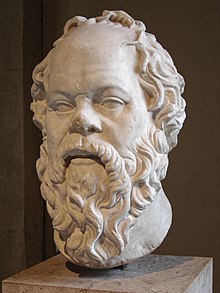
- Socrates - Socrates was a classical Greek (Athenian) philosopher credited as one of the founders of Western philosophy. He is an enigmatic figure known chiefly through the accounts of classical writers, especially the writings of his students Plato and Xenophon and the plays of his contemporary Aristophanes. Plato's dialogues are among the most comprehensive accounts of Socrates to survive from antiquity, though it is unclear the degree to which Socrates himself is "hidden behind his 'best disciple', Plato".
- platonic academy - The Academy was founded by Plato (428/427 BC – 348/347 BC) in ca. 387 BC in Athens. Aristotle (384 BC – 322 BC) studied there for twenty years (367 BC – 347 BC) before founding his own school, the Lyceum. The Academy persisted throughout the Hellenistic period as a skeptical school, until coming to an end after the death of Philo of Larissa in 83 BC. Although philosophers continued to teach Plato's philosophy in Athens during the Roman era, it was not until AD 410 that a revived Academy was established as a center for Neoplatonism, persisting until 529 AD when it was finally closed by Justinian I.The Platonic Academy has been cited by historians as the first higher learning institution in the Western world.
- Aristotle was a Greek philosopher and scientist born in the Macedonian city of Stagira, Chalkidice, on the northern periphery of Classical Greece. His father, Nicomachus, died when Aristotle was a child, whereafter Proxenus of Atarneus became his guardian.[3] At eighteen, he joined Plato's Academy in Athens and remained there until the age of thirty-seven (c. 347 BC). His writings cover many subjects – including physics, biology, zoology, metaphysics, logic, ethics, aesthetics, poetry, theater, music, rhetoric, linguistics, politics and government – and constitute the first comprehensive system of Western philosophy. Shortly after Plato died, Aristotle left Athens and, at the request of Philip of Macedon, tutored Alexander the Great starting from 343 BC. According to the Encyclopædia Britannica, "Aristotle was the first genuine scientist in history ... [and] every scientist is in his debt."

Aristotle's Poetics is the earliest surviving work of dramatic theory and the first extant philosophical treatise to focus on literary theory.
In it, Aristotle offers an account of what he calls "poetry" (a term which in Greek literally means "making" and in this context includes drama—comedy, tragedy, and the satyr play—as well as lyric poetry and epic poetry). They are similar in the fact that they are all imitations but different in the three ways that Aristotle describes:
1. Differences in music rhythm, harmony, meter and melody.
2. Difference of goodness in the characters.
3. Difference in how the narrative is presented: telling a story or acting it out.
- P O V - point of view
- Hubris means, in a modern context, extreme pride or self-confidence; in its ancient Greek context, it typically describes violent and excessive behavior rather than an attitude. When it offends the gods of ancient Greece, it is usually punished. The adjectival form of the noun hubris is "hubristic".Hubris is usually perceived as a characteristic of an individual rather than a group, although the group the offender belongs to may suffer consequences from the wrongful act. Hubris often indicates a loss of contact with reality and an overestimation of one's own competence, accomplishments or capabilities, especially when the person exhibiting it is in a position of power.
- hamartia - The term hamartia derives from the Greek ἁμαρτία, from ἁμαρτάνειν hamartánein, which means “to miss the mark” or “to err”. It is most often associated with Greek tragedy, although it is also used in Christian theology. Hamartia as it pertains to dramatic literature was first used by Aristotle in his Poetics. In tragedy, hamartia is commonly understood to refer to the protagonist’s error or flaw that leads to a chain of plot actions culminating in a reversal from their good fortune to bad. What qualifies as the error or flaw can include an error resulting from ignorance, an error of judgement, a flaw in character, or sin. The spectrum of meanings has invited debate among critics and scholars, and different interpretations among dramatists. => tragic flaw

沒有留言:
張貼留言