Week thirteen
Helen of troy :
Was this the face that launch'd a thousand ships,
And burnt the topless towers of Ilium?
Sweet Helen, make me immortal with a kiss.
Her lips suck forth my soul: see where it flies!
Come, Helen, come, give me my soul again.
Here will I dwell, for heaven is in these lips,
And all is dross that is not Helena.
I will be Paris, and for love of thee,
Instead of Troy, shall Wittenberg be sack'd;
And I will combat with weak Menelaus,
And wear thy colours on my plumed crest;
Yea, I will wound Achilles in the heel,
And then return to Helen for a kiss.
O, thou art fairer than the evening air
Clad in the beauty of a thousand stars;
Brighter art thou than flaming Jupiter
When he appear'd to hapless Semele;
More lovely than the monarch of the sky
In wanton Arethusa's azur'd arms;
And none but thou shalt be my paramour!
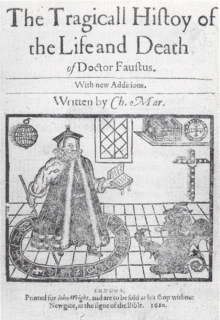
Doctor Faustus : The Tragical History of the Life and Death of Doctor Faustus, commonly referred to simply as Doctor Faustus, is a play by Christopher Marlowe, based on the German story Faust. Doctor Faustus was first published in 1604, eleven years after Marlowe's death and at least 10 years after the first performance of the play. It is the most controversial Elizabethan play outside of Shakespeare, with few critics coming to any agreement as to the date or the nature of the text.
Hubris : Hubris means, in a modern context, extreme pride or self-confidence; in its ancient Greek context, it typically describes violent and excessive behavior rather than an attitude. When it offends the gods of ancient Greece, it is usually punished.
Hubris is usually perceived as a characteristic of an individual rather than a group, although the group the offender belongs to may suffer consequences from the wrongful act. Hubris often indicates a loss of contact with reality and an overestimation of one's own competence, accomplishments or capabilities, especially when the person exhibiting it is in a position of power.
purple - 代表皇室的顏色
Deus ex mechina : Deus ex machina is a Latin calque from Greek ἀπὸ μηχανῆς θεός , meaning "god from the machine". The term has evolved to mean a plot device whereby a seemingly unsolvable problem is suddenly and abruptly resolved by the contrived and unexpected intervention of some new event, character, ability or object. Depending on how it is done, it can be intended to move the story forward when the writer has "painted himself into a corner" and sees no other way out, to surprise the audience, to bring the tale to a happy ending, or as a comedic device.The term was coined from the conventions of Greek tragedy, where a machine is used to bring actors playing gods onto the stage.
Tragedy : Tragedy is a form of drama based on human suffering that invokes an accompanying catharsis or pleasure in audiences. While many cultures have developed forms that provoke this paradoxical response, the term tragedy often refers to a specific tradition of drama that has played a unique and important role historically in the self-definition of Western civilization.That tradition has been multiple and discontinuous, yet the term has often been used to invoke a powerful effect of cultural identity and historical continuity—"the Greeks and the Elizabethans, in one cultural form; Hellenes and Christians, in a common activity," as Raymond Williams puts it.
tragic flaw : n.
A flaw in the character of the protagonist of a tragedy that brings the protagonist to ruin or sorrow.
chorus :
a. A group of singers who perform together, usually singing multi-part compositions with more than one singer for each part.
b. A group of vocalists and dancers who support the soloists and leading performers in operas, musical comedies, and revues.

沒有留言:
張貼留言