2015年12月22日 星期二

2015/12/23

week fifteen

Charles Dickens - Charles John Huffam Dickens (/ˈtʃɑrlz ˈdɪkɪnz/; 7 February 1812 – 9 June 1870) was an English writer and social critic. He created some of the world's best-known fictional characters and is regarded as the greatest novelist of the Victorian era. His works enjoyed unprecedented popularity during his lifetime, and by the twentieth century critics and scholars had recognised him as a literary genius. His novels and short stories enjoy lasting popularity.
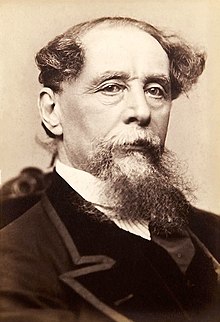
Charles Dickens

the christmas carol - A Christmas Carol in Prose, Being a Ghost-Story of Christmas,commonly known as A Christmas Carol, is a novella by Charles Dickens, first published in London by Chapman & Hall on 19 December 1843. The novella met with instant success and critical acclaim. A Christmas Carol tells the story of a bitter old miser named Ebenezer Scrooge and his transformation into a gentler, kindlier man after visitations by the ghost of his former business partner Jacob Marley and the Ghosts of Christmas Past, Present and Yet to Come.
The book was written at a time when the British were examining and exploring Christmas traditions from the past as well as new customs such as Christmas cards and Christmas trees. Carol singing took a new lease on life during this time. Dickens' sources for the tale appear to be many and varied, but are, principally, the humiliating experiences of his childhood, his sympathy for the poor, and various Christmas stories and fairy tales.

Scrooge - A scrooge is a miserly person. Scrooge may also refer to:Ebenezer Scrooge, the protagonist of Charles Dickens' novel A Christmas Carol. Ebenezer Scrooge is the focal character of Charles Dickens' 1843 novella, A Christmas Carol. At the beginning of the novella, Scrooge is a cold-hearted miser who despises Christmas. Dickens describes him thus: "The cold within him froze his old features, nipped his pointed nose, made his eyes red, his thin lips blue, and spoke out shrewdly in his grating voice...". His last name has come into the English language as a byword for miserliness and misanthropy. The tale of his redemption by the three Ghosts of Christmas (Ghost of Christmas Past, Ghost of Christmas Present, and Ghost of Christmas Yet to Come) has become a defining tale of the Christmas holiday in the English-speaking world. Ebenezer Scrooge is arguably both one of the most famous characters created by Charles Dickens and one of the most famous in English literature.
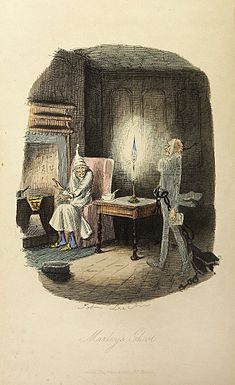
Marley's Ghost-John Leech, 1843.jpg

David Copperfield - David Copperfield (born David Seth Kotkin; September 16, 1956) is an American illusionist, and has been described by Forbes as the most commercially successful magician in history.
Copperfield's television specials have won 21 Emmy Awards of a total 38 nominations. Best known for his combination of storytelling and illusion, Copperfield's career of over 40 years has earned him 11 Guinness World Records, a star on the Hollywood Walk of Fame, a knighthood by the French government, and he has been named a Living Legend by the US Library of Congress.
DC Bullett Photo.jpg

David Copperfield - David Copperfield, (full title: The Personal History, Adventures, Experience and Observation of David Copperfield the Younger of Blunderstone Rookery (Which He Never Meant to Publish on Any Account)) is the eighth novel by Charles Dickens. It was first published as a serial in 1849–50, and as a book in 1850. Many elements of the novel follow events in Dickens' own life, and it is probably the most autobiographical of his novels. In the preface to the 1867 edition, Dickens wrote, "like many fond parents, I have in my heart of hearts a favourite child. And his name is David Copperfield."
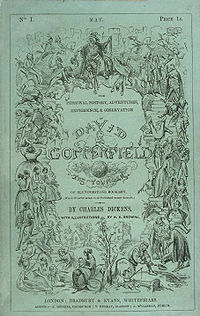
Copperfield cover serial.jpg

Meet Me in St. Louis - Meet Me in St. Louis is a 1944 musical film from Metro-Goldwyn-Mayer which tells the story of an American family living in St. Louis at the time of the Louisiana Purchase Exposition World's Fair in 1904.[3][4] The picture stars Judy Garland, Margaret O'Brien, Mary Astor, Lucille Bremer, Tom Drake, Leon Ames, Marjorie Main, June Lockhart, and Joan Carroll.
The movie was adapted by Irving Brecher and Fred F. Finklehoffe from a series of short stories by Sally Benson, originally published in The New Yorker magazine under the title "5135 Kensington", and later in novel form as Meet Me in St. Louis. The film was directed by Vincente Minnelli, who met Garland on the set and later married her. It was the second-highest grossing picture of the year, only behind Going My Way.
Meet Me In St Louis Poster.jpg

have yourself a merry little Christmas - https://www.youtube.com/watch?v=rnEqv8WcVq8


gay - 極度快樂

Jesus - Jesus, also referred to as Jesus of Nazareth or Jesus Christ, is the central figure of Christianity, whom the teachings of most Christian denominations hold to be the Son of God. Christianity regards Jesus as the awaited Messiah (or Christ) of the Old Testament.
Virtually all modern scholars of antiquity agree that Jesus existed historically, and historians consider the Synoptic Gospels (Matthew, Mark and Luke) to be the best sources for investigating the historical Jesus. Most scholars agree that Jesus was a Galilean, Jewish rabbi who preached his message orally,was baptized by John the Baptist, and was crucified by the order of the Roman Prefect Pontius Pilate. In the current mainstream view, Jesus was an apocalyptic preacher and the founder of a renewal movement within Judaism, although some prominent scholars argue that he was not apocalyptic. After Jesus' death, his followers believed he was resurrected, and the community they formed eventually became the Christian church. The widely used calendar era, abbreviated as "AD" or sometimes as "CE", is based on the birth of Jesus.
Christians believe that Jesus has a "unique significance" in the world. Christian doctrines include the beliefs that Jesus was conceived by the Holy Spirit, was born of a virgin named Mary, performed miracles, founded the Church, died by crucifixion as a sacrifice to achieve atonement, rose from the dead, and ascended into Heaven, whence he will return.Most Christians believe Jesus enables humans to be reconciled to God, and will judge the dead either before or after their bodily resurrection, an event tied to the Second Coming of Jesus in Christian eschatology; though some believe Jesus's role as savior has more existential or societal concerns than the afterlife, and a few notable theologians have suggested that Jesus will bring about a universal reconciliation. The great majority of Christians worship Jesus as the incarnation of God the Son, the second of three persons of a Divine Trinity. A few Christian groups reject Trinitarianism, wholly or partly, as non-scriptural.
In Islam, Jesus (commonly transliterated as Isa) is considered one of God's important prophets and the Messiah, second in importance only to Muhammad. To Muslims, Jesus was a bringer of scripture and was born of a virgin, but was not the Son of God. According to the Quran, Jesus was not crucified but was physically raised into Heaven by God. Judaism rejects the Christian and Islamic belief that Jesus was the awaited Messiah, arguing that he did not fulfill the Messianic prophecies in the Tanakh.
Cefalù Pantocrator retouched.jpg

According to the New Testament, Mary (Miriam: Hebrew: מרים‎; c. 18 BC – c. 43 AD), also known as St Mary the Virgin, the Blessed Virgin Mary, Saint Mary, Mary the Mother of God, or the Virgin Mary—amongst other titles, styles and honorifics—was a Galilean Jewish woman of Nazareth and the mother of Jesus.Mary has been venerated since Early Christianity,and is considered by millions to be the most meritorious saint of the religion. The Eastern and Oriental Orthodox, Roman Catholic, Anglican, and Lutheran Churches believe that Mary, as Mother of Jesus, is the Mother of God and the Theotokos, literally "Giver of birth to God". There is significant diversity in the Marian beliefs and devotional practices of major Christian traditions. The Roman Catholic Church holds distinctive Marian dogmas; namely her status as the mother of God; her Immaculate Conception; her perpetual virginity; and her Assumption into heaven. Many Protestants minimize Mary's role within Christianity, based on the argued brevity of biblical references. Mary (Maryam) also has a revered position in Islam, where a whole chapter of the Qur'an is devoted to her, also describing the birth of Jesus.


Joseph is an important person in the Hebrew Bible: his life connects the narrative of Abraham, Isaac and Jacob in Canaan to the subsequent narrative of the liberation of the Israelites from slavery in Egypt.
The Book of Genesis tells that Joseph was the 11th of Jacob's 12 sons and Rachel's firstborn, and tells how Joseph came to be sold into slavery by his jealous brothers, and rose to become vizier: the second most powerful man in Egypt next to Pharaoh. When famine struck Canaan, Jacob (Joseph's father) and Joseph's brothers came to the Land of Goshen in Egypt. According to the Book of Jubilees, Joseph was born on 1 Tammuz.


Saint Peter , also known as Simon Peter, Simeon, or Simōn, according to the New Testament, was one of the Twelve Apostles of Jesus Christ, leaders of the early Christian Church. The Roman Catholic Church considers him to be the first Pope, ordained by Jesus in the "Rock of My Church" dialogue in Matthew 16:18. The ancient Christian churches all venerate Peter as a major saint and associate him with founding the Church of Antioch and later the Church in Rome, but differ about the authority of his various successors in present-day Christianity.
The New Testament indicates that Peter was the son of John (or Jonah or Jona) and was from the village of Bethsaida in the province of Galilee or Gaulanitis. His brother Andrew was also an apostle. According to New Testament accounts, Peter was one of twelve apostles chosen by Jesus from his first disciples. Originally a fisherman, he played a leadership role and was with Jesus during events witnessed by only a few apostles, such as the Transfiguration. According to the gospels, Peter confessed Jesus as the Messiah, was part of Jesus's inner circle, thrice denied Jesus, and preached on the day of Pentecost.
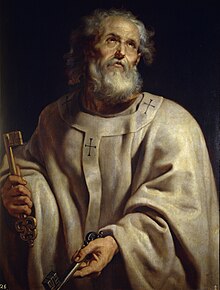
Pope-peter pprubens.jpg

Vatican City, is a walled enclave within the city of Rome. With an area of approximately 44 hectares (110 acres), and a population of 842, it is the smallest internationally recognized independent state in the world by both area and population.It is an ecclesiastical[3] or sacerdotal-monarchical state ruled by the Bishop of Rome – the Pope. The highest state functionaries are all Catholic clergy of various national origins. Since the return of the Popes from Avignon in 1377, they have generally resided at the Apostolic Palace within what is now Vatican City, although at times residing instead in the Quirinal Palace in Rome or elsewhere.


The Five Books of Moses: Genesis, Exodus, Leviticus, Numbers, Deuteronomy The Book of Moses, dictated by Joseph Smith, is part of the scriptural canon for some in the Latter Day Saint movement. The book begins with the "Visions of Moses," a prologue to the story of the creation and the fall of man (Moses chapter 1), and continues with material corresponding to Smith's revision (JST) of the first six chapters of the Book of Genesis (Moses chapters 2–5, 8), interrupted by two chapters of "extracts from the prophecy of Enoch" (Moses chapters 6–7). Portions of the Book of Moses were originally published separately by The Church of Jesus Christ of Latter-day Saints (LDS Church) in 1851, but later combined and published as the Book of Moses in the Pearl of Great Price, one of the four books of its scriptural canon. The same material is published by the Community of Christ as parts of its Doctrine and Covenants and Inspired Version of the Bible.
「five books of moses wiki」的圖片搜尋結果


2015年12月17日 星期四

2015/12/16

week fourteen

  • 因為並不是每個人都信基督=> happy holiday

  • How to take good note?
  1. Don't write down fact,write conclusion
  2. use color
  3. review


  • Self-abuse:Self-harm, the intentional, direct injuring of one's own body without suicidal intentions
  • declare 宣布停戰
  • abs-禁止
  • Plato - was a philosopher and mathematician in Classical Greece, and the founder of the Academy in Athens, the first institution of higher learning in the Western world. He is widely considered the most pivotal figure in the development of philosophy, especially the Western tradition. Unlike nearly all of his philosophical contemporaries, Plato's entire œuvre is believed to have survived intact for over 2,400 years.
Plato Silanion Musei Capitolini MC1377.jpg
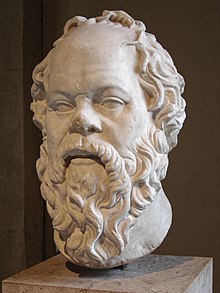
  • Socrates - Socrates was a classical Greek (Athenian) philosopher credited as one of the founders of Western philosophy. He is an enigmatic figure known chiefly through the accounts of classical writers, especially the writings of his students Plato and Xenophon and the plays of his contemporary Aristophanes. Plato's dialogues are among the most comprehensive accounts of Socrates to survive from antiquity, though it is unclear the degree to which Socrates himself is "hidden behind his 'best disciple', Plato".
A bust of Socrates


  • platonic academy - The Academy was founded by Plato (428/427 BC – 348/347 BC) in ca. 387 BC in Athens. Aristotle (384 BC – 322 BC) studied there for twenty years (367 BC – 347 BC) before founding his own school, the Lyceum. The Academy persisted throughout the Hellenistic period as a skeptical school, until coming to an end after the death of Philo of Larissa in 83 BC. Although philosophers continued to teach Plato's philosophy in Athens during the Roman era, it was not until AD 410 that a revived Academy was established as a center for Neoplatonism, persisting until 529 AD when it was finally closed by Justinian I.The Platonic Academy has been cited by historians as the first higher learning institution in the Western world.


  • Aristotle was a Greek philosopher and scientist born in the Macedonian city of Stagira, Chalkidice, on the northern periphery of Classical Greece. His father, Nicomachus, died when Aristotle was a child, whereafter Proxenus of Atarneus became his guardian.[3] At eighteen, he joined Plato's Academy in Athens and remained there until the age of thirty-seven (c. 347 BC). His writings cover many subjects – including physics, biology, zoology, metaphysics, logic, ethics, aesthetics, poetry, theater, music, rhetoric, linguistics, politics and government – and constitute the first comprehensive system of Western philosophy. Shortly after Plato died, Aristotle left Athens and, at the request of Philip of Macedon, tutored Alexander the Great starting from 343 BC. According to the Encyclopædia Britannica, "Aristotle was the first genuine scientist in history ... [and] every scientist is in his debt."
Aristotle Altemps Inv8575.jpg

Aristotle's Poetics is the earliest surviving work of dramatic theory and the first extant philosophical treatise to focus on literary theory.
In it, Aristotle offers an account of what he calls "poetry" (a term which in Greek literally means "making" and in this context includes drama—comedy, tragedy, and the satyr play—as well as lyric poetry and epic poetry). They are similar in the fact that they are all imitations but different in the three ways that Aristotle describes:

1. Differences in music rhythm, harmony, meter and melody.
2. Difference of goodness in the characters.
3. Difference in how the narrative is presented: telling a story or acting it out.

  • P O V - point of view

  • Hubris means, in a modern context, extreme pride or self-confidence; in its ancient Greek context, it typically describes violent and excessive behavior rather than an attitude. When it offends the gods of ancient Greece, it is usually punished. The adjectival form of the noun hubris is "hubristic".Hubris is usually perceived as a characteristic of an individual rather than a group, although the group the offender belongs to may suffer consequences from the wrongful act. Hubris often indicates a loss of contact with reality and an overestimation of one's own competence, accomplishments or capabilities, especially when the person exhibiting it is in a position of power.
  • hamartia - The term hamartia derives from the Greek ἁμαρτία, from ἁμαρτάνειν hamartánein, which means “to miss the mark” or “to err”. It is most often associated with Greek tragedy, although it is also used in Christian theology. Hamartia as it pertains to dramatic literature was first used by Aristotle in his Poetics. In tragedy, hamartia is commonly understood to refer to the protagonist’s error or flaw that leads to a chain of plot actions culminating in a reversal from their good fortune to bad. What qualifies as the error or flaw can include an error resulting from ignorance, an error of judgement, a flaw in character, or sin. The spectrum of meanings has invited debate among critics and scholars, and different interpretations among dramatists. => tragic flaw

2015年12月9日 星期三

2015/12/09

Week thirteen

Helen of troy : 
Was this the face that launch'd a thousand ships,
And burnt the topless towers of Ilium?
Sweet Helen, make me immortal with a kiss.
Her lips suck forth my soul: see where it flies!
Come, Helen, come, give me my soul again.
Here will I dwell, for heaven is in these lips,
And all is dross that is not Helena.
I will be Paris, and for love of thee,
Instead of Troy, shall Wittenberg be sack'd;
And I will combat with weak Menelaus,
And wear thy colours on my plumed crest;
Yea, I will wound Achilles in the heel,
And then return to Helen for a kiss.
O, thou art fairer than the evening air
Clad in the beauty of a thousand stars;
Brighter art thou than flaming Jupiter
When he appear'd to hapless Semele;
More lovely than the monarch of the sky
In wanton Arethusa's azur'd arms;
And none but thou shalt be my paramour!

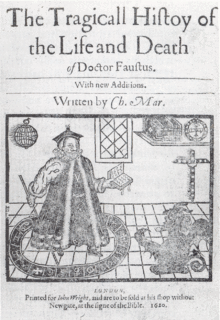
 Doctor Faustus : The Tragical History of the Life and Death of Doctor Faustus, commonly referred to simply as Doctor Faustus, is a play by Christopher Marlowe, based on the German story Faust. Doctor Faustus was first published in 1604, eleven years after Marlowe's death and at least 10 years after the first performance of the play. It is the most controversial Elizabethan play outside of Shakespeare, with few critics coming to any agreement as to the date or the nature of the text.
Faustus-tragedy.gif

Hubris : Hubris means, in a modern context, extreme pride or self-confidence; in its ancient Greek context, it typically describes violent and excessive behavior rather than an attitude. When it offends the gods of ancient Greece, it is usually punished. 
Hubris is usually perceived as a characteristic of an individual rather than a group, although the group the offender belongs to may suffer consequences from the wrongful act. Hubris often indicates a loss of contact with reality and an overestimation of one's own competence, accomplishments or capabilities, especially when the person exhibiting it is in a position of power.

purple - 代表皇室的顏色


Deus ex mechina : Deus ex machina  is a Latin calque from Greek ἀπὸ μηχανῆς θεός , meaning "god from the machine". The term has evolved to mean a plot device whereby a seemingly unsolvable problem is suddenly and abruptly resolved by the contrived and unexpected intervention of some new event, character, ability or object. Depending on how it is done, it can be intended to move the story forward when the writer has "painted himself into a corner" and sees no other way out, to surprise the audience, to bring the tale to a happy ending, or as a comedic device.The term was coined from the conventions of Greek tragedy, where a machine is used to bring actors playing gods onto the stage.
「Deus ex machina」的圖片搜尋結果


Tragedy : Tragedy is a form of drama based on human suffering that invokes an accompanying catharsis or pleasure in audiences. While many cultures have developed forms that provoke this paradoxical response, the term tragedy often refers to a specific tradition of drama that has played a unique and important role historically in the self-definition of Western civilization.That tradition has been multiple and discontinuous, yet the term has often been used to invoke a powerful effect of cultural identity and historical continuity—"the Greeks and the Elizabethans, in one cultural form; Hellenes and Christians, in a common activity," as Raymond Williams puts it.

tragic flaw : n.
A flaw in the character of the protagonist of a tragedy that brings the protagonist to ruin or sorrow.

chorus :
a. A group of singers who perform together, usually singing multi-part compositions with more than one singer for each part.
b. A group of vocalists and dancers who support the soloists and leading performers in operas, musical comedies, and revues.

2015年12月2日 星期三

2015/12/02

week twelve

  • Dionysia : The Dionysia was a large festival in ancient Athens in honor of the god Dionysus, the central events of which were the theatrical performances of dramatic tragedies and, from 487 BC, comedies. It was the second-most important festival after the Panathenaia. The Dionysia actually consisted of two related festivals, the Rural Dionysia and the City Dionysia, which took place in different parts of the year. They were also an essential part of the Dionysian Mysteries.
  • Deus ex mechina : Deus ex machina  is a Latin calque from Greek ἀπὸ μηχανῆς θεός , meaning "god from the machine". The term has evolved to mean a plot device whereby a seemingly unsolvable problem is suddenly and abruptly resolved by the contrived and unexpected intervention of some new event, character, ability or object. Depending on how it is done, it can be intended to move the story forward when the writer has "painted himself into a corner" and sees no other way out, to surprise the audience, to bring the tale to a happy ending, or as a comedic device.The term was coined from the conventions of Greek tragedy, where a machine is used to bring actors playing gods onto the stage.
  •  
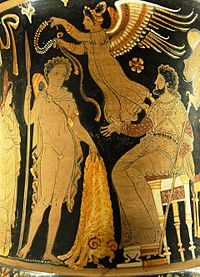
  • Medea : In Greek mythology, Medea is a sorceress who was the daughter of King Aeëtes of Colchis, niece of Circe, granddaughter of the sun god Helios, and later wife to the hero Jason, with whom she had two children, Mermeros and Pheres. In Euripides's play Medea, Jason leaves Medea when Creon, king of Corinth, offers him his daughter, Glauce.The play tells of Medea avenging her husband's betrayal by killing their children.                                                   
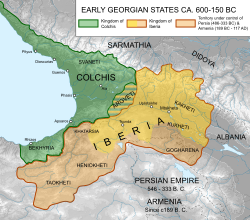
  • Colchis : In Greco-Roman geography, Colchis was the name for a region in the Southern Caucasus. Colchis was located on the eastern coast of the Black Sea, centered on present-day western Georgia. Around the 1st centuries BC and AD the land south of the Greater Caucasus and north of the Lesser Caucasus was divided between Kolchis in the west, Caucasian Iberia in the center and Caucasian Albania in the east. To the southwest was Armenia and to the southeast Atropatene.
        
  • Golden fleece : In Greek mythology, the Golden Fleece is the fleece of the gold-hair winged ram, which was held in Colchis. The fleece is a symbol of authority and kingship. It figures in the tale of the hero Jason and his band of Argonauts, who set out on a quest for the fleece by order of King Pelias, in order to place Jason rightfully on the throne of Iolcus in Thessaly. Through the help of Medea, they acquire the Golden Fleece. The story is of great antiquity and was current in the time of Homer (eighth century BC). It survives in various forms, among which the details vary.               
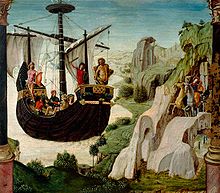
  • Argo : In Greek mythology, Argo was the ship on which Jason and the Argonauts sailed from Iolcos to retrieve the Golden Fleece. She was named after her builder, Argus.Argo was constructed by the shipwright Argus, and its crew were specially protected by the goddess Hera. The best source for the myth is the Argonautica by Apollonius Rhodius. According to a variety of sources of the legend, Argo was said to have been planned or constructed with the help of Athena. According to other legends she contained in her prow a magical piece of timber from the sacred forest of Dodona, which could speak and render prophecies. After the successful journey, Argo was consecrated to Poseidon in the Isthmus of Corinth. She was then translated into the sky and turned into the constellation of Argo Navis.
         
  • Argonaut : The Argonauts were a band of heroes in Greek mythology, who in the years before the Trojan War, around 1300 B.CE, accompanied Jason to Colchis in his quest to find the Golden Fleece. Their name comes from their ship, Argo, named after its builder, Argus. "Argonauts" literally means "Argo sailors". They were sometimes called Minyans, after a prehistoric tribe in the area.


  • Chorus : A Greek chorus is a homogeneous, non-individualised group of performers in the plays of classical Greece, who comment with a collective voice on the dramatic action.[1] The chorus consisted of between 12 and 50 players, who variously danced, sang or spoke their lines in unison and sometimes wore masks.
  • heroine 女英雄
  • Fido Dido :
           「fido dido」的圖片搜尋結果

  • Aristophanes : Aristophanes, son of Philippus, of the deme Cydathenaeum, was a comic playwright of ancient Athens. Eleven of his thirty plays survive virtually complete. These, together with fragments of some of his other plays, provide the only real examples of a genre of comic drama known as Old Comedy, and they are used to define the genre.
Aristophanes - Project Gutenberg eText 12788.png

2015年11月26日 星期四

2015/11/25

Week eleven

Drama  - is the specific mode of narrative, typically fictional, represented in performance.The structure of dramatic texts, unlike other forms of literature, is directly influenced by this collaborative production and collective reception. The early modern tragedy Hamlet (1601) by Shakespeare and the classical Athenian tragedy Oedipus the King (c. 429 BC) by Sophocles are among the masterpieces of the art of drama.A modern example is Long Day's Journey into Night (1956) by Eugene O’Neill. Drama is often combined with music and dance: the drama in opera is generally sung throughout; musicals generally include both spoken dialogue and songs; and some forms of drama have incidental music or musical accompaniment underscoring the dialogue
 「drama」的圖片搜尋結果

Dionysus - Dionysus is the god of the grape harvest, wine making and wine, of ritual madness, fertility, theater and religious ecstasy in Greek mythology. Alcohol, especially wine, played an important role in Greek culture with Dionysus being an important reason for this life style.He is a major, popular figure of Greek mythology and religion, and is included in some lists of the twelve Olympians. Dionysus was the last god to be accepted into Mt. Olympus. He was the youngest and the only one to have a mortal mother.His festivals were the driving force behind the development of Greek theater. Modern scholarship categorises him as a dying-and-rising god.
Dionysos Louvre Ma87 n2.jpg

Semele - Semele, in Greek mythology, daughter of the Boeotian hero Cadmus and Harmonia, was the mortal mother of Dionysus by Zeus in one of his many origin myths.

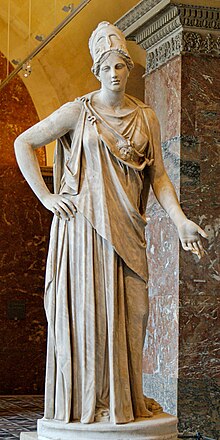
Athena - Athena or Athene, often given the epithet Pallas, is the goddess of wisdom, courage, inspiration, civilization, law and justice, mathematics, strength, war strategy, the arts, crafts, and skill in ancient Greek religion and mythology. Minerva is the Roman goddess identified with Athena.Athena is known for her calm temperament.
Mattei Athena Louvre Ma530 n2.jpg

Thespis - Thespis of Icaria (present-day Dionysos, Greece), according to certain Ancient Greek sources and especially Aristotle, was the first person ever to appear on stage as an actor playing a character in a play (instead of speaking as him or herself). In other sources, he is said to have introduced the first principal actor in addition to the chorus.Thespis was a singer of dithyrambs (songs about stories from mythology with choric refrains). He is credited with introducing a new style in which one singer or actor performed the words of individual characters in the stories, distinguishing between the characters with the aid of different masks.This new style was called tragedy, and Thespis was the most popular exponent of it.
「thespis」的圖片搜尋結果

The Chorus (French: Les Choristes) -  is a 2004 German-Swiss-French drama film directed by Christophe Barratier. Co-written by Barratier and Philippe Lopes-Curval (fr), it is an adaptation of the 1945 film A Cage of Nightingales (La Cage aux rossignols).The plot involves the widely successful orchestra conductor Pierre Morhange (Jacques Perrin), who returns to France when his mother dies. He reminisces about his childhood inspirations when he and his former classmate Pépinot (Didier Flamand) read the diary of their old music teacher Clément Mathieu (Gérard Jugnot). In 1949, a young Morhange is the badly behaved son of single mother Violette (Marie Bunel). He attends the boarding institution for "difficult" boys, Fond de L'Étang ("Bottom of the Pond"), presided over by strict headmaster Mr Rachin (François Berléand). New teacher Mathieu brightens up the school and assembles a choir, leading to the discovery of Morhange's musical and physical talents and a transformation in the children. At the 77th Academy Awards, The Chorus was nominated for Best Foreign Language Film and Best Original Song (the latter for "Vois sur ton chemin", listed as "Look to Your Path").
LesChoristes.jpeg

dithyramb - The dithyramb was an ancient Greek hymn sung and danced in honor of Dionysus, the god of wine and fertility; the term was also used as an epithet of the god: Plato, in The Laws, while discussing various kinds of music mentions "the birth of Dionysos, called, I think, the dithyramb." Plato also remarks in the Republic that dithyrambs are the clearest example of poetry in which the poet is the only speaker.

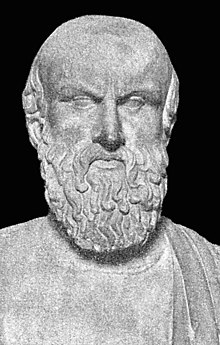
Aeschylus - Aeschylus was an ancient Greek tragedian. He is also the first whose plays still survive; the others are Sophocles and Euripides. He is often described as the father of tragedy: critics and scholars' knowledge of the genre begins with his work, and understanding of earlier tragedies is largely based on inferences from his surviving plays. According to Aristotle, he expanded the number of characters in plays to allow conflict among them whereas characters previously had interacted only with the chorus.
Aischylos Büste.jpg


Peloponnesian War - The Peloponnesian War (431–404 BC) was an ancient Greek war fought by Athens and its empire against the Peloponnesian League led by Sparta. Historians have traditionally divided the war into three phases.The Peloponnesian War reshaped the ancient Greek world. On the level of international relations, Athens, the strongest city-state in Greece prior to the war's beginning, was reduced to a state of near-complete subjection, while Sparta became established as the leading power of Greece.  The Peloponnesian War marked the dramatic end to the fifth century BC and the golden age of Greece.
Peloponnesian war alliances 431 BC.png

Catharsis - Catharsis is the purification and purgation of emotions—especially pity and fear—through art or any extreme change in emotion that results in renewal and restoration. It is a metaphor originally used by Aristotle in the Poetics, comparing the effects of tragedy on the mind of spectator to the effect of a cathartic on the body.

2015年11月19日 星期四

2015/11/18

Week ten

Les Misérables - Les Misérables  is a French historical novel by Victor Hugo, first published in 1862, that is considered one of the greatest novels of the 19th century. Les Misérables has been popularized through numerous adaptations for the stage, television, and film, including a musical and a film adaptation of that musical.
Les Misérables
Jean Valjean.JPG
Jean Valjean as Monsieur Madeleine. Illustration by Gustave Brion
AuthorVictor Hugo
IllustratorEmile Bayard
CountryFrance
LanguageFrench
GenreEpic novel, historical fiction
PublisherA. Lacroix, Verboeckhoven & Cie.
Publication date
1862
Genre -  "kind" or "sort", from Latin genus, Greek is any category of literature, music or other forms of art or entertainment, whether written or spoken, audio or visual, based on some set of stylistic criteria. Genres are formed by conventions that change over time as new genres are invented and the use of old ones are discontinued. Often, works fit into multiple genres by way of borrowing and recombining these conventions.

Dithyramb - The dithyramb was an ancient Greek hymn sung and danced in honor of Dionysus, the god of wine and fertility; the term was also used as an epithet of the god: Plato, in The Laws, while discussing various kinds of music mentions "the birth of Dionysos, called, I think, the dithyramb." Plato also remarks in the Republic that dithyrambs are the clearest example of poetry in which the poet is the only speaker.

YOUTH by Samuel Ullman (1840-1924)


Youth is not a time of life—it is a state of mind. 
It is not a matter of red cheeks, red lips and supple knees. 
It is a temper of the will; a quality of the imagination; a vigor of the emotions; 
it is a freshness of the deep springs of life. 

Youth means a tempermental predominance of courage over timidity, 
of the appetite for adventure over a life of ease. 
This often exists in a man of fifty, more than in a boy of twenty. 
Nobody grows old by merely living a number of years; 
people grow old by deserting their ideals.

Years may wrinkle the skin, but to give up enthusiasm wrinkles the soul. 
Worry, doubt, self-distrust, fear and despair—
these are the long, long years that bow the head 
and turn the growing spirit back to dust.

Whether seventy or sixteen, there is in every being’s heart a love of wonder; 
the sweet amazement at the stars and starlike things and thoughts; 
the undaunted challenge of events, 
the unfailing childlike appetite for what comes next, 
and the joy in the game of life.

You are as young as your faith, as old as your doubt;
as young as your self-confidence, as old as your fear, 
as young as your hope, as old as your despair.

In the central place of your heart there is a wireless station. 
So long as it receives messages of beauty, hope, cheer, grandeur, courage, 
and power from the earth, from men and from the Infinite—so long are you young.
When the wires are all down and the central places of your heart are covered with the snows of pessimism and the ice of cynicism,
then are you grown old, indeed!

「youth is a state of mind」的圖片搜尋結果

2015年11月16日 星期一

2015/11/04

Week eight

fair - 美麗
affair - 緋聞
Pygmalion - Pygmalion is a legendary figure of Cyprus. Though Pygmalion is the Greek version of the Phoenician royal name Pumayyaton,he is most familiar from Ovid's narrative poem Metamorphoses, in which Pygmalion was a sculptor who fell in love with a statue he had carved.

Galatea - Galatea is a name popularly applied to the statue carved of ivory by Pygmalion of Cyprus, which then came to life, in Greek mythology; in modern English the name usually alludes to that story. Galatea is also the name of Polyphemus's object of desire in Theocritus's Idylls VI and XI and is linked with Polyphemus again in the myth of Acis and Galatea in Ovid's Metamorphoses.

Protagonist - The protagonist, meaning "player of the first part, chief actor") or main character is a narrative's central or primary personal figure, who comes into conflict with an opposing major character or force (called the antagonist).[1] The audience is intended to mostly identify with the protagonist. In the theater of Ancient Greece, three actors played every main dramatic role in a tragedy; the protagonist played the leading role while the other roles were played by the deuteragonist and the tritagonist.


2015/10/21

week six

In medias res : For example, Hamlet begins after the death of Hamlet's father. Characters make reference to King Hamlet's death without the plot's first establishment of said fact. Since the play focuses on Hamlet and the revenge itself more so than the motivation, Shakespeare utilizes in medias res to bypass superfluous exposition.Works that employ in medias res often, though not always, subsequently use flashback and nonlinear narrative for exposition of earlier events in order to fill in the backstory. For example, in Homer's Odyssey, we first learn about Odysseus' journey when he is held captive on Calypso's island. We then find out, in Books IX through XII, that the greater part of Odysseus' journey precedes that moment in the narrative. On the other hand, Homer's Iliad has relatively few flashbacks, although it opens in the thick of the Trojan War.

argos peacock : 

siren : 女妖
In Greek mythology, the Sirens were dangerous yet beautiful creatures, who lured nearby sailors with their enchanting music and voices to shipwreck on the rocky coast of their island.

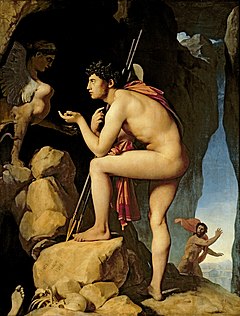
Oedipus : Oedipus was a mythical Greek king of Thebes, the son and killer of Laius, son and consort of Jocasta, and father and sibling of Polynices, Eteocles, Antigone, and Ismene. A tragic hero in Greek mythology, Oedipus accidentally fulfilled the prophecy, despite his efforts not to, that he would end up killing his father and marrying his mother, thereby bringing disaster to his city and family. When the truth was discovered, his wife-mother hanged herself, and Oedipus gouged out his own eyes. They had four children together. 

Electra : In Greek mythology, Electra was the daughter of King Agamemnon and Queen Clytemnestra, and thus princess of Argos.[1] She and her brother Orestes plotted revenge against their mother Clytemnestra and stepfather Aegisthus for the murder of their father, Agamemnon.


Ithaca, New York

From top left: Ithaca during winter, Ithaca during autumn, Cornell University, Ithaca Commons (downtown), Hemlock Gorge in Ithaca, Ithaca Falls