2015年11月26日 星期四

2015/11/25

Week eleven

Drama  - is the specific mode of narrative, typically fictional, represented in performance.The structure of dramatic texts, unlike other forms of literature, is directly influenced by this collaborative production and collective reception. The early modern tragedy Hamlet (1601) by Shakespeare and the classical Athenian tragedy Oedipus the King (c. 429 BC) by Sophocles are among the masterpieces of the art of drama.A modern example is Long Day's Journey into Night (1956) by Eugene O’Neill. Drama is often combined with music and dance: the drama in opera is generally sung throughout; musicals generally include both spoken dialogue and songs; and some forms of drama have incidental music or musical accompaniment underscoring the dialogue
 「drama」的圖片搜尋結果

Dionysus - Dionysus is the god of the grape harvest, wine making and wine, of ritual madness, fertility, theater and religious ecstasy in Greek mythology. Alcohol, especially wine, played an important role in Greek culture with Dionysus being an important reason for this life style.He is a major, popular figure of Greek mythology and religion, and is included in some lists of the twelve Olympians. Dionysus was the last god to be accepted into Mt. Olympus. He was the youngest and the only one to have a mortal mother.His festivals were the driving force behind the development of Greek theater. Modern scholarship categorises him as a dying-and-rising god.
Dionysos Louvre Ma87 n2.jpg

Semele - Semele, in Greek mythology, daughter of the Boeotian hero Cadmus and Harmonia, was the mortal mother of Dionysus by Zeus in one of his many origin myths.

Athena - Athena or Athene, often given the epithet Pallas, is the goddess of wisdom, courage, inspiration, civilization, law and justice, mathematics, strength, war strategy, the arts, crafts, and skill in ancient Greek religion and mythology. Minerva is the Roman goddess identified with Athena.Athena is known for her calm temperament.
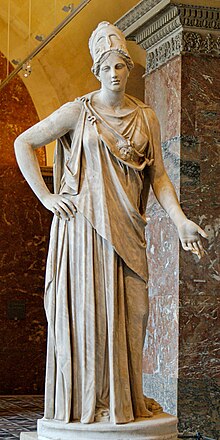
Mattei Athena Louvre Ma530 n2.jpg

Thespis - Thespis of Icaria (present-day Dionysos, Greece), according to certain Ancient Greek sources and especially Aristotle, was the first person ever to appear on stage as an actor playing a character in a play (instead of speaking as him or herself). In other sources, he is said to have introduced the first principal actor in addition to the chorus.Thespis was a singer of dithyrambs (songs about stories from mythology with choric refrains). He is credited with introducing a new style in which one singer or actor performed the words of individual characters in the stories, distinguishing between the characters with the aid of different masks.This new style was called tragedy, and Thespis was the most popular exponent of it.
「thespis」的圖片搜尋結果

The Chorus (French: Les Choristes) -  is a 2004 German-Swiss-French drama film directed by Christophe Barratier. Co-written by Barratier and Philippe Lopes-Curval (fr), it is an adaptation of the 1945 film A Cage of Nightingales (La Cage aux rossignols).The plot involves the widely successful orchestra conductor Pierre Morhange (Jacques Perrin), who returns to France when his mother dies. He reminisces about his childhood inspirations when he and his former classmate Pépinot (Didier Flamand) read the diary of their old music teacher Clément Mathieu (Gérard Jugnot). In 1949, a young Morhange is the badly behaved son of single mother Violette (Marie Bunel). He attends the boarding institution for "difficult" boys, Fond de L'Étang ("Bottom of the Pond"), presided over by strict headmaster Mr Rachin (François Berléand). New teacher Mathieu brightens up the school and assembles a choir, leading to the discovery of Morhange's musical and physical talents and a transformation in the children. At the 77th Academy Awards, The Chorus was nominated for Best Foreign Language Film and Best Original Song (the latter for "Vois sur ton chemin", listed as "Look to Your Path").
LesChoristes.jpeg

dithyramb - The dithyramb was an ancient Greek hymn sung and danced in honor of Dionysus, the god of wine and fertility; the term was also used as an epithet of the god: Plato, in The Laws, while discussing various kinds of music mentions "the birth of Dionysos, called, I think, the dithyramb." Plato also remarks in the Republic that dithyrambs are the clearest example of poetry in which the poet is the only speaker.

Aeschylus - Aeschylus was an ancient Greek tragedian. He is also the first whose plays still survive; the others are Sophocles and Euripides. He is often described as the father of tragedy: critics and scholars' knowledge of the genre begins with his work, and understanding of earlier tragedies is largely based on inferences from his surviving plays. According to Aristotle, he expanded the number of characters in plays to allow conflict among them whereas characters previously had interacted only with the chorus.
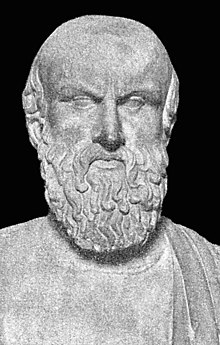
Aischylos Büste.jpg


Peloponnesian War - The Peloponnesian War (431–404 BC) was an ancient Greek war fought by Athens and its empire against the Peloponnesian League led by Sparta. Historians have traditionally divided the war into three phases.The Peloponnesian War reshaped the ancient Greek world. On the level of international relations, Athens, the strongest city-state in Greece prior to the war's beginning, was reduced to a state of near-complete subjection, while Sparta became established as the leading power of Greece.  The Peloponnesian War marked the dramatic end to the fifth century BC and the golden age of Greece.
Peloponnesian war alliances 431 BC.png

Catharsis - Catharsis is the purification and purgation of emotions—especially pity and fear—through art or any extreme change in emotion that results in renewal and restoration. It is a metaphor originally used by Aristotle in the Poetics, comparing the effects of tragedy on the mind of spectator to the effect of a cathartic on the body.

2015年11月19日 星期四

2015/11/18

Week ten

Les Misérables - Les Misérables  is a French historical novel by Victor Hugo, first published in 1862, that is considered one of the greatest novels of the 19th century. Les Misérables has been popularized through numerous adaptations for the stage, television, and film, including a musical and a film adaptation of that musical.
Les Misérables
Jean Valjean.JPG
Jean Valjean as Monsieur Madeleine. Illustration by Gustave Brion
AuthorVictor Hugo
IllustratorEmile Bayard
CountryFrance
LanguageFrench
GenreEpic novel, historical fiction
PublisherA. Lacroix, Verboeckhoven & Cie.
Publication date
1862
Genre -  "kind" or "sort", from Latin genus, Greek is any category of literature, music or other forms of art or entertainment, whether written or spoken, audio or visual, based on some set of stylistic criteria. Genres are formed by conventions that change over time as new genres are invented and the use of old ones are discontinued. Often, works fit into multiple genres by way of borrowing and recombining these conventions.

Dithyramb - The dithyramb was an ancient Greek hymn sung and danced in honor of Dionysus, the god of wine and fertility; the term was also used as an epithet of the god: Plato, in The Laws, while discussing various kinds of music mentions "the birth of Dionysos, called, I think, the dithyramb." Plato also remarks in the Republic that dithyrambs are the clearest example of poetry in which the poet is the only speaker.

YOUTH by Samuel Ullman (1840-1924)


Youth is not a time of life—it is a state of mind. 
It is not a matter of red cheeks, red lips and supple knees. 
It is a temper of the will; a quality of the imagination; a vigor of the emotions; 
it is a freshness of the deep springs of life. 

Youth means a tempermental predominance of courage over timidity, 
of the appetite for adventure over a life of ease. 
This often exists in a man of fifty, more than in a boy of twenty. 
Nobody grows old by merely living a number of years; 
people grow old by deserting their ideals.

Years may wrinkle the skin, but to give up enthusiasm wrinkles the soul. 
Worry, doubt, self-distrust, fear and despair—
these are the long, long years that bow the head 
and turn the growing spirit back to dust.

Whether seventy or sixteen, there is in every being’s heart a love of wonder; 
the sweet amazement at the stars and starlike things and thoughts; 
the undaunted challenge of events, 
the unfailing childlike appetite for what comes next, 
and the joy in the game of life.

You are as young as your faith, as old as your doubt;
as young as your self-confidence, as old as your fear, 
as young as your hope, as old as your despair.

In the central place of your heart there is a wireless station. 
So long as it receives messages of beauty, hope, cheer, grandeur, courage, 
and power from the earth, from men and from the Infinite—so long are you young.
When the wires are all down and the central places of your heart are covered with the snows of pessimism and the ice of cynicism,
then are you grown old, indeed!

「youth is a state of mind」的圖片搜尋結果

2015年11月16日 星期一

2015/11/04

Week eight

fair - 美麗
affair - 緋聞
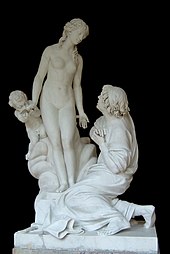
Pygmalion - Pygmalion is a legendary figure of Cyprus. Though Pygmalion is the Greek version of the Phoenician royal name Pumayyaton,he is most familiar from Ovid's narrative poem Metamorphoses, in which Pygmalion was a sculptor who fell in love with a statue he had carved.

Galatea - Galatea is a name popularly applied to the statue carved of ivory by Pygmalion of Cyprus, which then came to life, in Greek mythology; in modern English the name usually alludes to that story. Galatea is also the name of Polyphemus's object of desire in Theocritus's Idylls VI and XI and is linked with Polyphemus again in the myth of Acis and Galatea in Ovid's Metamorphoses.

Protagonist - The protagonist, meaning "player of the first part, chief actor") or main character is a narrative's central or primary personal figure, who comes into conflict with an opposing major character or force (called the antagonist).[1] The audience is intended to mostly identify with the protagonist. In the theater of Ancient Greece, three actors played every main dramatic role in a tragedy; the protagonist played the leading role while the other roles were played by the deuteragonist and the tritagonist.


2015/10/21

week six

In medias res : For example, Hamlet begins after the death of Hamlet's father. Characters make reference to King Hamlet's death without the plot's first establishment of said fact. Since the play focuses on Hamlet and the revenge itself more so than the motivation, Shakespeare utilizes in medias res to bypass superfluous exposition.Works that employ in medias res often, though not always, subsequently use flashback and nonlinear narrative for exposition of earlier events in order to fill in the backstory. For example, in Homer's Odyssey, we first learn about Odysseus' journey when he is held captive on Calypso's island. We then find out, in Books IX through XII, that the greater part of Odysseus' journey precedes that moment in the narrative. On the other hand, Homer's Iliad has relatively few flashbacks, although it opens in the thick of the Trojan War.

argos peacock : 

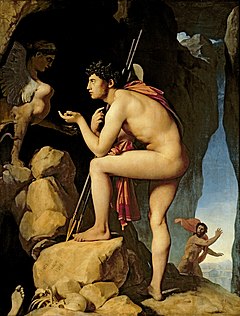
siren : 女妖
In Greek mythology, the Sirens were dangerous yet beautiful creatures, who lured nearby sailors with their enchanting music and voices to shipwreck on the rocky coast of their island.

Oedipus : Oedipus was a mythical Greek king of Thebes, the son and killer of Laius, son and consort of Jocasta, and father and sibling of Polynices, Eteocles, Antigone, and Ismene. A tragic hero in Greek mythology, Oedipus accidentally fulfilled the prophecy, despite his efforts not to, that he would end up killing his father and marrying his mother, thereby bringing disaster to his city and family. When the truth was discovered, his wife-mother hanged herself, and Oedipus gouged out his own eyes. They had four children together. 

Electra : In Greek mythology, Electra was the daughter of King Agamemnon and Queen Clytemnestra, and thus princess of Argos.[1] She and her brother Orestes plotted revenge against their mother Clytemnestra and stepfather Aegisthus for the murder of their father, Agamemnon.


Ithaca, New York

From top left: Ithaca during winter, Ithaca during autumn, Cornell University, Ithaca Commons (downtown), Hemlock Gorge in Ithaca, Ithaca Falls