2016年1月8日 星期五

2016年1月6日 星期三
2016/01/07
week seventeen
Delilah is a character in the Hebrew bible Book of Judges, where she is the "woman in the valley of Sorek" whom Samson loved, and who was his downfall. Her figure, one of several dangerous temptresses in the Hebrew Bible, has become emblematic: "Samson loved Delilah, she betrayed him, and, what is worse, she did it for money," Madlyn Kahr begins her study of the Delilah motif in European painting.
The story of Samson in Judges 13–16 portrays a man who was given great strength by God but who ultimately loses his strength when Delilah allows the Philistines to shave his hair during his slumber (Judges 16:19). Samson was born into an Israelite family, the son of Manoah and his wife who is never named. Both are visited by the Angel of the Lord and told that their child will be a Nazirite from birth.
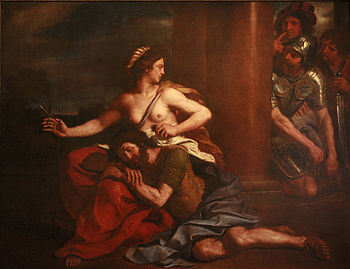
fatal woman - A femme fatale is a stock character of a mysterious and seductive woman whose charms ensnare her lovers, often leading them into compromising, dangerous, and deadly situations. She is an archetype of literature and art. Her ability to entrance and hypnotise her victim with a spell was in the earliest stories seen as being literally supernatural; hence, the femme fatale today is still often described as having a power akin to an enchantress, seductress, vampire, witch, or demon, having power over men.The phrase is French for "fatal woman".

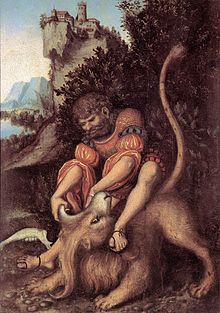
Samson , or Sampson , is one of the last of the judges of the ancient Israelites mentioned in the Hebrew Bible (Book of Judges chapters 13 to 16).
According to the biblical account, Samson was given supernatural strength by God in order to combat his enemies and perform heroic feats such as killing a lion, slaying an entire army with only the jawbone of an ass, and destroying a pagan temple. Samson had two vulnerabilities, however: his attraction to untrustworthy women and his hair, without which he was powerless. These vulnerabilities ultimately proved fatal for him.
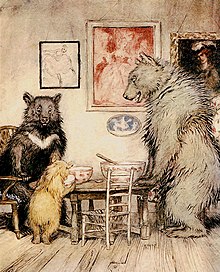
"Goldilocks and the Three Bears" and the older "The Story of the Three Bears" are two variations of an old fairy tale. The original tale tells of an ugly, old woman who enters the forest home of three bachelor bears whilst they are away. She sits in their chairs, eats some of their porridge, and falls asleep in one of their beds. When the bears return and discover her, she starts up, jumps from the window, and is never seen again. The other major version brings Goldilocks to the tale (replacing the old woman), and an even later version retained Goldilocks, but has the three bachelor bears transformed into Papa, Mama, and Baby Bear.
What was originally a fearsome oral tale became a cosy family story with only a hint of menace. The story has elicited various interpretations and has been adapted to film, opera, and other media. "The Story of the Three Bears" is one of the most popular fairy tales in the English language.

seven locks of hair
John Milton (9 December 1608 – 8 November 1674) was an English poet, polemicist, man of letters, and a civil servant for the Commonwealth of England under Oliver Cromwell. He wrote at a time of religious flux and political upheaval, and is best known for his epic poem Paradise Lost (1667), written in blank verse.
Milton's poetry and prose reflect deep personal convictions, a passion for freedom and self-determination, and the urgent issues and political turbulence of his day. Writing in English, Latin, Greek, and Italian, he achieved international renown within his lifetime, and his celebrated Areopagitica (1644)—written in condemnation of pre-publication censorship—is among history's most influential and impassioned defences of free speech and freedom of the press.
William Hayley's 1796 biography called him the "greatest English author", and he remains generally regarded "as one of the preeminent writers in the English language", though critical reception has oscillated in the centuries since his death (often on account of his republicanism). Samuel Johnson praised Paradise Lost as "a poem which...with respect to design may claim the first place, and with respect to performance, the second, among the productions of the human mind", though he (a Tory and recipient of royal patronage) described Milton's politics as those of an "acrimonious and surly republican".

Paradise Lost is an epic poem in blank verse by the 17th-century English poet John Milton (1608–1674). The first version, published in 1667, consisted of ten books with over ten thousand lines of verse. A second edition followed in 1674, arranged into twelve books (in the manner of Virgil's Aeneid) with minor revisions throughout and a note on the versification.It is considered by critics to be Milton's major work, and it helped solidify his reputation as one of the greatest English poets of his time.
The poem concerns the Biblical story of the Fall of Man: the temptation of Adam and Eve by the fallen angel Satan and their expulsion from the Garden of Eden. Milton's purpose, stated in Book I, is to "justify the ways of God to men".

Satan is a figure appearing in the texts of the Abrahamic religions who brings evil and temptation, and is known as the deceiver who leads humanity astray. Some religious groups teach that he originated as an angel who fell out of favor with God, seducing humanity into the ways of sin, and who has power in the fallen world. In the Hebrew Bible and the New Testament, Satan is primarily an accuser and adversary, a decidedly malevolent entity, also called the devil, who possesses demonic qualities.
In Theistic Satanism, Satan is considered a positive force and deity who is either worshipped or revered. In LaVeyan Satanism, Satan is regarded as holding virtuous characteristics.

Satan=Lucifer=Prince of darkness
Durante degli Alighieri, simply called Dante , was a major Italian poet of the late Middle Ages. His Divine Comedy, originally called Comedìa (modern Italian: Commedia) and later christened Divina by Boccaccio, is widely considered the greatest literary work composed in the Italian language and a masterpiece of world literature.
In the late Middle Ages, the overwhelming majority of poetry was written in Latin, and therefore accessible only to affluent and educated audiences. In De vulgari eloquentia (On Eloquence in the Vernacular), however, Dante defended use of the vernacular in literature. He himself would even write in the Tuscan dialect for works such as The New Life (1295) and the aforementioned Divine Comedy; this choice, although highly unorthodox, set a hugely important precedent that later Italian writers such as Petrarch and Boccaccio would follow. As a result, Dante played an instrumental role in establishing the national language of Italy. Dante's significance also extends past his home country; his depictions of Hell, Purgatory, and Heaven have provided inspiration for a large body of Western art, and are cited as an influence on the works of John Milton, Geoffrey Chaucer, William Shakespeare, and Lord Alfred Tennyson, among many others. In addition, the first use of the interlocking three-line rhyme scheme, or the terza rima, is attributed to him.
Dante has been called "the Father of the Italian language". In Italy, Dante is often referred to as il Sommo Poeta ("the Supreme Poet") and il Poeta; he, Petrarch, and Boccaccio are also called "the three fountains" or "the three crowns".
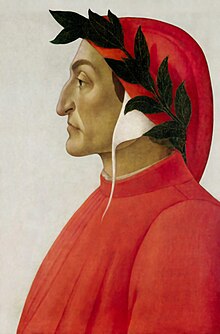
The Divine Comedy is an epic poem by Dante Alighieri, begun c. 1308 and completed 1320, a year before his death in 1321. It is widely considered the preeminent work of Italian literature and is seen as one of the greatest works of world literature. The poem's imaginative vision of the afterlife is representative of the medieval world-view as it had developed in the Western Church by the 14th century. It helped establish the Tuscan language, in which it is written, as the standardized Italian language. It is divided into three parts: Inferno, Purgatorio, and Paradiso.
On the surface, the poem describes Dante's travels through Hell, Purgatory, and Paradise or Heaven; but at a deeper level, it represents, allegorically, the soul's journey towards God. At this deeper level, Dante draws on medieval Christian theology and philosophy, especially Thomistic philosophy and the Summa Theologica of Thomas Aquinas. Consequently, the Divine Comedy has been called "the Summa in verse".
The work was originally simply titled Comedìa and the word Divina was added by Giovanni Boccaccio. The first printed edition to add the word divina to the title was that of the Venetian humanist Lodovico Dolce, published in 1555 by Gabriele Giolito de' Ferrari.
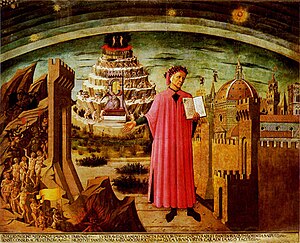
Florence is the capital city of the Italian region of Tuscany and of the province of Florence. It is the most populous city in Tuscany, with approximately 382,000 inhabitants, expanding to over 1,520,000 in the metropolitan area.
Florence is famous for its history: a centre of medieval European trade and finance and one of the wealthiest cities of the time, it is considered the birthplace of the Renaissance, and has been called "the Athens of the Middle Ages".


Purgatorio is the second part of Dante's Divine Comedy, following the Inferno, and preceding the Paradiso. The poem was written in the early 14th century. It is an allegory telling of the climb of Dante up the Mount of Purgatory, guided by the Roman poet Virgil, except for the last four cantos at which point Beatrice takes over as Dante's guide. In the poem, Purgatory is depicted as a mountain in the Southern Hemisphere, consisting of a bottom section (Ante-Purgatory), seven levels of suffering and spiritual growth (associated with the seven deadly sins), and finally the Earthly Paradise at the top. Allegorically, the poem represents the Christian life, and in describing the climb Dante discusses the nature of sin, examples of vice and virtue, as well as moral issues in politics and in the Church. The poem outlines a theory that all sin arises from love – either perverted love directed towards others' harm, or deficient love, or the disordered or excessive love of good things.

The seven deadly sins, also known as the capital vices or cardinal sins, is a Western religious grouping and classification of vices. This grouping emerged in the fourth century AD and was used for Christian ethical education and for confession. According to the Catechism of the Catholic Church, a mortal or deadly sin is believed to destroy the life of grace and charity within a person. Though the sins have fluctuated over time, the currently recognized list includes pride, greed, lust, envy, gluttony, wrath and sloth. There is a parallel tradition of seven virtues.
The tradition of seven deadly sins as we know it today originated with the desert fathers, specifically Evagrius Ponticus. Evagrius identified seven or eight evil thoughts or spirits that one needed to overcome. Evagrius' pupil John Cassian brought that tradition to Europe with his book The Institutes. The idea of seven basic vices or sins was fundamental to Catholic confessional practices as evidence in penitential manuals as well as sermons like "The Parson's Tale" from Chaucer's Canterbury Tales. This connection is also clear in how Dante's Purgatory is arranged according to the seven deadly sins. The concept of seven deadly sins was used throughout the medieval Christian world to teach young people how to avoid evil and embrace the good as is evident in treatises, paintings, sculpture decorations on churches. Works like Peter Brueghel the Elder's prints of the Seven Deadly Sins as well as Edmund Spencer's The Faerie Queene show the continuity of this tradition into the modern era. A commonly used mnemonic acronym to remember the seven deadly sins is "SALIGIA," based on the first letters in Latin of the seven deadly sins: superbia, avaritia, luxuria, invidia, gula, ira, acedia.

Hubris means, in a modern context, extreme pride or self-confidence; in its ancient Greek context, it typically describes violent and excessive behavior rather than an attitude. When it offends the gods of ancient Greece, it is usually punished. The adjectival form of the noun hubris is "hubristic".
Hubris is usually perceived as a characteristic of an individual rather than a group, although the group the offender belongs to may suffer consequences from the wrongful act. Hubris often indicates a loss of contact with reality and an overestimation of one's own competence, accomplishments or capabilities, especially when the person exhibiting it is in a position of power.

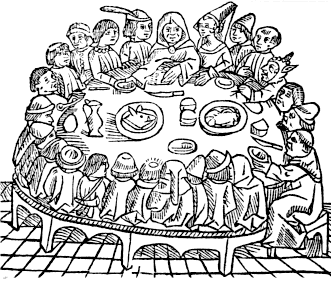
The Canterbury Tales (Middle English: Tales of Caunterbury) is a collection of 24 stories that runs to over 17,000 lines written in Middle English by Geoffrey Chaucer. In 1386 Chaucer became Controller of Customs and Justice of Peace and then three years later in 1389 Clerk of the King's work. It was during these years that Chaucer began working on his most famous text, The Canterbury Tales. The tales (mostly written in verse, although some are in prose) are presented as part of a story-telling contest by a group of pilgrims as they travel together on a journey from London to Canterbury in order to visit the shrine of Saint Thomas Becket at Canterbury Cathedral. The prize for this contest is a free meal at the Tabard Inn at Southwark on their return.
Daniel "Dan" Brown (born June 22, 1964) is an American author of thriller fiction who is best known for the 2003 bestselling novel The Da Vinci Code. Brown's novels are treasure hunts set in a 24-hour period, and feature the recurring themes of cryptography, keys, symbols, codes, and conspiracy theories. His books have been translated into 52 languages, and as of 2012, sold over 200 million copies. Three of them, Angels & Demons (2000), The Da Vinci Code (2003), and Inferno (2013), have been/are being adapted into films.

Inferno is a 2013 mystery thriller novel by American author Dan Brown and the fourth book in his Robert Langdon series, following Angels & Demons, The Da Vinci Code and The Lost Symbol.[1] The book was released on May 14, 2013 by Doubleday. It was number one on the New York Times Best Seller list for hardcover fiction and Combined Print & E-book fiction for the first eleven weeks of its release, and also remained on the list of E-book fiction for the first seventeen weeks of its release.





In the late Middle Ages, the overwhelming majority of poetry was written in Latin, and therefore accessible only to affluent and educated audiences. In De vulgari eloquentia (On Eloquence in the Vernacular), however, Dante defended use of the vernacular in literature. He himself would even write in the Tuscan dialect for works such as The New Life (1295) and the aforementioned Divine Comedy; this choice, although highly unorthodox, set a hugely important precedent that later Italian writers such as Petrarch and Boccaccio would follow. As a result, Dante played an instrumental role in establishing the national language of Italy. Dante's significance also extends past his home country; his depictions of Hell, Purgatory, and Heaven have provided inspiration for a large body of Western art, and are cited as an influence on the works of John Milton, Geoffrey Chaucer, William Shakespeare, and Lord Alfred Tennyson, among many others. In addition, the first use of the interlocking three-line rhyme scheme, or the terza rima, is attributed to him.
Dante has been called "the Father of the Italian language". In Italy, Dante is often referred to as il Sommo Poeta ("the Supreme Poet") and il Poeta; he, Petrarch, and Boccaccio are also called "the three fountains" or "the three crowns".
The Divine Comedy is an epic poem by Dante Alighieri, begun c. 1308 and completed 1320, a year before his death in 1321. It is widely considered the preeminent work of Italian literature and is seen as one of the greatest works of world literature. The poem's imaginative vision of the afterlife is representative of the medieval world-view as it had developed in the Western Church by the 14th century. It helped establish the Tuscan language, in which it is written, as the standardized Italian language. It is divided into three parts: Inferno, Purgatorio, and Paradiso.
On the surface, the poem describes Dante's travels through Hell, Purgatory, and Paradise or Heaven; but at a deeper level, it represents, allegorically, the soul's journey towards God. At this deeper level, Dante draws on medieval Christian theology and philosophy, especially Thomistic philosophy and the Summa Theologica of Thomas Aquinas. Consequently, the Divine Comedy has been called "the Summa in verse".
The work was originally simply titled Comedìa and the word Divina was added by Giovanni Boccaccio. The first printed edition to add the word divina to the title was that of the Venetian humanist Lodovico Dolce, published in 1555 by Gabriele Giolito de' Ferrari.
Florence is the capital city of the Italian region of Tuscany and of the province of Florence. It is the most populous city in Tuscany, with approximately 382,000 inhabitants, expanding to over 1,520,000 in the metropolitan area.
Florence is famous for its history: a centre of medieval European trade and finance and one of the wealthiest cities of the time, it is considered the birthplace of the Renaissance, and has been called "the Athens of the Middle Ages".
Purgatorio is the second part of Dante's Divine Comedy, following the Inferno, and preceding the Paradiso. The poem was written in the early 14th century. It is an allegory telling of the climb of Dante up the Mount of Purgatory, guided by the Roman poet Virgil, except for the last four cantos at which point Beatrice takes over as Dante's guide. In the poem, Purgatory is depicted as a mountain in the Southern Hemisphere, consisting of a bottom section (Ante-Purgatory), seven levels of suffering and spiritual growth (associated with the seven deadly sins), and finally the Earthly Paradise at the top. Allegorically, the poem represents the Christian life, and in describing the climb Dante discusses the nature of sin, examples of vice and virtue, as well as moral issues in politics and in the Church. The poem outlines a theory that all sin arises from love – either perverted love directed towards others' harm, or deficient love, or the disordered or excessive love of good things.
The seven deadly sins, also known as the capital vices or cardinal sins, is a Western religious grouping and classification of vices. This grouping emerged in the fourth century AD and was used for Christian ethical education and for confession. According to the Catechism of the Catholic Church, a mortal or deadly sin is believed to destroy the life of grace and charity within a person. Though the sins have fluctuated over time, the currently recognized list includes pride, greed, lust, envy, gluttony, wrath and sloth. There is a parallel tradition of seven virtues.
The tradition of seven deadly sins as we know it today originated with the desert fathers, specifically Evagrius Ponticus. Evagrius identified seven or eight evil thoughts or spirits that one needed to overcome. Evagrius' pupil John Cassian brought that tradition to Europe with his book The Institutes. The idea of seven basic vices or sins was fundamental to Catholic confessional practices as evidence in penitential manuals as well as sermons like "The Parson's Tale" from Chaucer's Canterbury Tales. This connection is also clear in how Dante's Purgatory is arranged according to the seven deadly sins. The concept of seven deadly sins was used throughout the medieval Christian world to teach young people how to avoid evil and embrace the good as is evident in treatises, paintings, sculpture decorations on churches. Works like Peter Brueghel the Elder's prints of the Seven Deadly Sins as well as Edmund Spencer's The Faerie Queene show the continuity of this tradition into the modern era. A commonly used mnemonic acronym to remember the seven deadly sins is "SALIGIA," based on the first letters in Latin of the seven deadly sins: superbia, avaritia, luxuria, invidia, gula, ira, acedia.
Hubris means, in a modern context, extreme pride or self-confidence; in its ancient Greek context, it typically describes violent and excessive behavior rather than an attitude. When it offends the gods of ancient Greece, it is usually punished. The adjectival form of the noun hubris is "hubristic".
Hubris is usually perceived as a characteristic of an individual rather than a group, although the group the offender belongs to may suffer consequences from the wrongful act. Hubris often indicates a loss of contact with reality and an overestimation of one's own competence, accomplishments or capabilities, especially when the person exhibiting it is in a position of power.
The Canterbury Tales (Middle English: Tales of Caunterbury) is a collection of 24 stories that runs to over 17,000 lines written in Middle English by Geoffrey Chaucer. In 1386 Chaucer became Controller of Customs and Justice of Peace and then three years later in 1389 Clerk of the King's work. It was during these years that Chaucer began working on his most famous text, The Canterbury Tales. The tales (mostly written in verse, although some are in prose) are presented as part of a story-telling contest by a group of pilgrims as they travel together on a journey from London to Canterbury in order to visit the shrine of Saint Thomas Becket at Canterbury Cathedral. The prize for this contest is a free meal at the Tabard Inn at Southwark on their return.
Daniel "Dan" Brown (born June 22, 1964) is an American author of thriller fiction who is best known for the 2003 bestselling novel The Da Vinci Code. Brown's novels are treasure hunts set in a 24-hour period, and feature the recurring themes of cryptography, keys, symbols, codes, and conspiracy theories. His books have been translated into 52 languages, and as of 2012, sold over 200 million copies. Three of them, Angels & Demons (2000), The Da Vinci Code (2003), and Inferno (2013), have been/are being adapted into films.
Inferno is a 2013 mystery thriller novel by American author Dan Brown and the fourth book in his Robert Langdon series, following Angels & Demons, The Da Vinci Code and The Lost Symbol.[1] The book was released on May 14, 2013 by Doubleday. It was number one on the New York Times Best Seller list for hardcover fiction and Combined Print & E-book fiction for the first eleven weeks of its release, and also remained on the list of E-book fiction for the first seventeen weeks of its release.
The burning bush is an object described by the Book of Exodus as being located on Mount Horeb. According to the narrative, the bush was on fire, but was not consumed by the flames, hence the name. In the biblical narrative, the burning bush is the location at which Moses was appointed by Yahweh (God) to lead the Israelites out of Egypt and intoCanaan.
The Hebrew word used in the narrative, that is translated into English as bush, is seneh (סנה), which refers in particular tobrambles; seneh is a biblical dis legomenon, only appearing in two places, both of which describe the burning bush. It is possible that the reference to a burning bush is based on a mistaken interpretation of Sinai (סיני), a mountain described by the Bible as being on fire. Another possibility is that the use of seneh (סנה) may be a deliberate pun on Sinai (סיני), a feature common in Yahwistic texts.
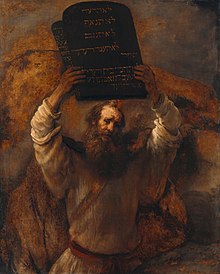
Moses is a prophet in Abrahamic religions. According to the Hebrew Bible, he was a former Egyptian prince who later in life became a religious leader and lawgiver, to whom the authorship of the Torah is traditionally attributed. The historical consensus is that Moses is not an historical figure. Also called Moshe Rabbenu in Hebrew (מֹשֶׁה רַבֵּנוּ, lit. "Moses our Teacher"), he is the most important prophet in Judaism. He is also an important prophet in Christianity, Islam, Baha'ism as well as a number of other faiths.
According to the Book of Exodus, Moses was born in a time when his people, the Israelites, an enslaved minority, were increasing in numbers and the Egyptian Pharaoh was worried that they might ally with Egypt's enemies. Moses' Hebrew mother, Jochebed, secretly hid him when the Pharaoh ordered all newborn Hebrew boys to be killed in order to reduce the population of the Israelites. Through the Pharaoh's daughter (identified as Queen Bithia in the Midrash), the child was adopted as a foundling from the Nile river and grew up with the Egyptian royal family. After killing an Egyptian slavemaster (because the slavemaster was smiting a Hebrew), Moses fled across the Red Sea to Midian, where he encountered the God of Israel speaking to him from within a "burning bush which was not consumed by the fire" on Mount Horeb (which he regarded as the Mountain of God).
God sent Moses back to Egypt to demand the release of the Israelites from slavery. Moses said that he could not speak with assurance or eloquence, so God allowed Aaron, his brother, to become his spokesperson. After the Ten Plagues, Moses led the Exodus of the Israelites out of Egypt and across the Red Sea, after which they based themselves at Mount Sinai, where Moses received the Ten Commandments. After 40 years of wandering in the desert, Moses died within sight of the Promised Land.
Rabbinical Judaism calculated a lifespan of Moses corresponding to 1391–1271 (120 years) BCE; Jerome gives 1592 BCE, and Ussher 1571 BCE as his birth year.
Canaan was, during the late 2nd millennium BC, a region in the Ancient Near East. In the Bible it corresponds to the Levant, in particular the areas of the Southern Levant that are the main setting of the narrative of the Hebrew Bible, i.e. the area of Israel, Phoenicia, Philistia, and other nations.Canaan was of significant geopolitical importance in the Late Bronze Age Amarna period as the area where the spheres of interest of the Egyptian, Hittite, and Assyrian Empires converged. Much of the modern knowledge about Canaan stems from archaeological excavation in this area at sites such as Tel Hazor, Tel Megiddo, and Gezer. Canaanite culture apparently developed in situ from the Circum-Arabian Nomadic Pastoral Complex, which in turn developed from a fusion of Near Eastern Harifian hunter-gatherers with Pre-Pottery Neolithic B (PPNB) farming cultures, practicing animal domestication, during the 6200 BC climatic crisis. The Late Bronze Age state of Ugarit (at Ras Shamra in Syria) is considered quintessentially Canaanite archaeologically, even though its Ugaritic language does not belong to the Canaanite group proper.
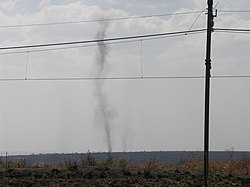
A whirlwind is a weather phenomenon in which a vortex of wind (a vertically oriented rotating column of air) forms due to instabilities and turbulence created by heating and flow (current) gradients. Whirlwinds occur all over the world and in any season.
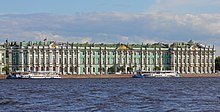
Hermitage Museum - The State Hermitage is a museum of art and culture in Saint Petersburg, Russia. One of the largest and oldest museums in the world, it was founded in 1764 by Catherine the Great and has been open to the public since 1852. Its collections, of which only a small part is on permanent display, comprise over three million items, including the largest collection of paintings in the world. The collections occupy a large complex of six historic buildings along Palace Embankment, including the Winter Palace, a former residence of Russian emperors. Apart from them, the Menshikov Palace, Museum of Porcelain, Storage Facility at Staraya Derevnya and the eastern wing of the General Staff Building are also part of the museum. The museum has several exhibition centers abroad. The Hermitage is a federal state property. Since 1990, the director of the museum has been Mikhail Piotrovsky.
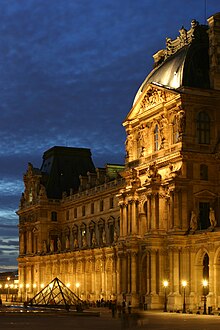
The Louvre or the Louvre Museum is one of the world's largest museums and a historic monument in Paris, France. A central landmark of the city, it is located on the Right Bank of the Seine in the 1st arrondissement (ward). Nearly 350,000 objects from prehistory to the 21st century are exhibited over an area of 60,600 square metres (652,300 square feet). The Louvre is the world's most visited museum, receiving more than 9.26 million visitors in 2014.
The British Museum is a museum dedicated to human history, art, and culture, located in the Bloomsbury area of London. Its permanent collection, numbering some 8 million works, is among the largest and most comprehensive in existence and originates from all continents, illustrating and documenting the story of human culture from its beginnings to the present.
The Plagues of Egypt , also called the ten biblical plagues, were ten calamities that, according to the biblical Book of Exodus, the God of Israel inflicted upon Egypt to persuade the Pharaoh to release the ill-treated Israelites from slavery. Pharaoh capitulated after the tenth plague, triggering the Exodus of the Hebrew people. The plagues served to contrast the power of the God of Israel with the Egyptian gods, invalidating them. Some commentators have associated several of the plagues with judgment on specific gods associated with the Nile, fertility and natural phenomena. According to Exodus 12:12, all the gods of Egypt would be judged through the tenth and final plague: "On that same night I will pass through Egypt and strike down every firstborn of both people and animals, and I will bring judgment on all the gods of Egypt. I am the LORD."
"Thou shalt not take the name of the Lord thy God in vain" (KJV; also "You shall not make wrongful use of the name of the Lord your God" (NRSV) and variants) is one of the Ten Commandments.
Jesus knocking at the door
2016年1月1日 星期五
2015/12/29
week sixteen
Psalm 23 : In the 23rd Psalm (Greek numbering: Psalm 22) in the Hebrew Bible/Old Testament, the writer describes God as his Shepherd. The text, beloved by Jews and Christians alike, is often alluded to in popular media and has been set to music many times.
Psalm 23
A psalm of David.
The Lord is my shepherd, I lack nothing.
He makes me lie down in green pastures,
he leads me beside quiet waters,
he refreshes my soul.
He guides me along the right paths
for his name’s sake.
Even though I walk
through the darkest valley,
I will fear no evil,
for you are with me;
your rod and your staff,
they comfort me.
You prepare a table before me
in the presence of my enemies.
You anoint my head with oil;
my cup overflows.
Surely your goodness and love will follow me
all the days of my life,
and I will dwell in the house of the Lord
forever.

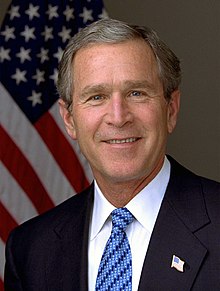
George Walker Bush (born July 6, 1946) is an American politician and businessman who served as the 43rd President of the United States from 2001 to 2009, and the 46th Governor of Texas from 1995 to 2000. The eldest son of Barbara and George H. W. Bush, he was born in New Haven, Connecticut. After graduating from Yale University in 1968 and Harvard Business School in 1975, he worked in oil businesses. He married Laura Welch in 1977 and ran unsuccessfully for the House of Representatives shortly thereafter. He later co-owned the Texas Rangers baseball team before defeating Ann Richards in the 1994 Texas gubernatorial election. He was elected president in 2000 after a close and controversial election, becoming the fourth president to be elected while receiving fewer popular votes nationwide than his opponent. He is the second president to have been the son of a former president, the first having been John Quincy Adams. He is also the brother of Jeb Bush, who is a former Governor of Florida and candidate for the Republican presidential nomination in the 2016 presidential election.
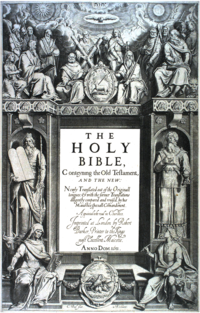
king james bible : The King James Version (KJV), also known as the Authorized Version (AV) or King James Bible (KJB), is an English translation of the Christian Bible for the Church of England that begun in 1604 and completed in 1611.
First printed by the King's Printer Robert Barker, this was the third translation into English to be approved by the English Church authorities. The first was the Great Bible commissioned in the reign of King Henry VIII (1535), and the second was the Bishops' Bible of 1568.[3] In January 1604, James I convened the Hampton Court Conference where a new English version was conceived in response to the perceived problems of the earlier translations as detected by the Puritans,[4] a faction within the Church of England.[5] The translation is widely considered a towering achievement in English literature, as both beautiful and scholarly.
The ancient legend of Orpheus and Eurydice concerns the fateful love of Orpheus of Thrace, son of Apollo and the muse Calliope, for the beautiful Eurydice (from Eurudike, "she whose justice extends widely"). It may be a late addition to the Orpheus myths, as the latter cult-title suggests those attached to Persephone. It may have been derived from a legend in which Orpheus travels to Tartarus and charms the goddess Hecate.

In psychology, the psyche is the totality of the human mind, conscious and unconscious. Psychology is the scientific or objective study of the psyche. The word has a long history of use in psychology and philosophy, dating back to ancient times, and represents one of the fundamental concepts for understanding human nature from a scientific point of view. The English word soul is sometimes used synonymously, especially in older texts.
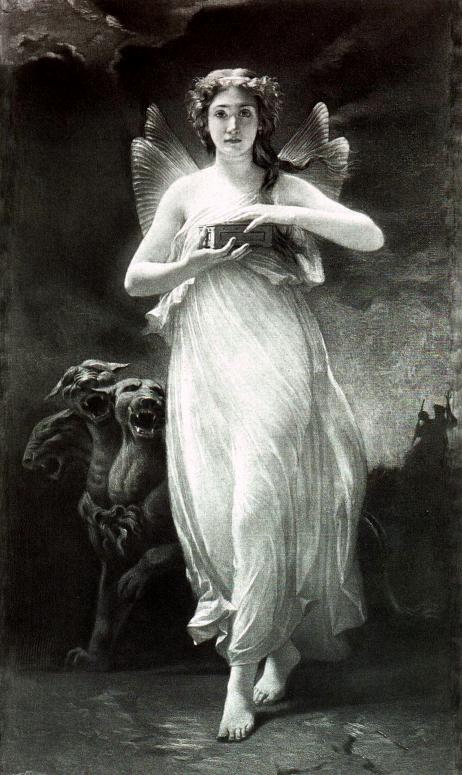
In Greek mythology, Styx is a deity and a river that formed the boundary between Earth and the Underworld (the domain often called Hades, which also is the name of its ruler). The rivers Styx, Phlegethon, Acheron, Lethe, and Cocytus all converge at the center of the underworld on a great marsh, which sometimes, also is called the Styx. According to Herodotus the river Styx originates near Feneos. Styx also is a goddess with prehistoric roots in Greek mythology as a daughter of Tethys, after whom the river is named and because of whom it had miraculous powers.

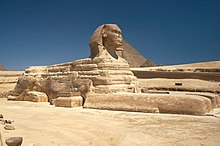
The sphinx is a mythical creature with, as a minimum, the head of a human and the body of a lion.
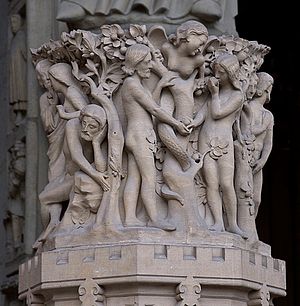
the Fall bible : In Christian theology, the fall of man, or the fall, is a term used to describe the transition of the first man and woman from a state of innocent obedience to God to a state of guilty disobedience. Although not named in the Bible, the doctrine of the fall comes from a biblical interpretation of Genesis chapter 3. At first, Adam and Eve lived with God in the Garden of Eden, but the serpent tempted them into eating the fruit from the tree of knowledge of good and evil, which God had forbidden. After doing so, they became ashamed of their nakedness and God expelled them from the Garden to prevent them from eating from the tree of life and becoming immortal.
Niagara Falls is the collective name for three waterfalls that straddle the international border between Canada and the United States; more specifically, between the province of Ontario and the state of New York. They form the southern end of the Niagara Gorge.

Free will is the ability to choose between different possible courses of action. It is closely linked to the concepts of responsibility, praise, guilt, sin, and other judgments which apply only to actions that are freely chosen. It is also connected with the concepts of advice, persuasion, deliberation, and prohibition. Traditionally, only actions that are freely willed are seen as deserving credit or blame. There are numerous different concerns about threats to the possibility of free will, varying by how exactly it is conceived, which is a matter of some debate.

Prometheus, is a Titan in Greek mythology, best known as the deity in Greek mythology who was the creator of mankind and its greatest benefactor, who gave mankind fire stolen from Mount Olympus. Prometheus sided with Zeus and the ascending Olympian gods in the vast cosmological struggle against Cronus (Kronos) and the other Titans. Prometheus was therefore on the conquering side of the cataclysmic war of the Greek gods, the Titanomachy, where Zeus and the Olympian gods ultimately defeated Cronus and the other Titans.

In Greek mythology, Pandora was the first human woman created by the gods, specifically by Hephaestus and Athena on the instructions of Zeus. As Hesiod related it, each god helped create her by giving her unique gifts. Zeus ordered Hephaestus to mold her out of earth as part of the punishment of humanity for Prometheus' theft of the secret of fire, and all the gods joined in offering her "seductive gifts". Her other name—inscribed against her figure on a white-ground kylix in the British Museum—is Anesidora, "she who sends up gifts"

In Greek mythology, Epimetheus was the brother of Prometheus (traditionally interpreted as "foresight", literally "fore-thinker"), a pair of Titans who "acted as representatives of mankind" (Kerenyi 1951, p 207). They were the sons of Iapetus, who in other contexts was the father of Atlas. While Prometheus is characterized as ingenious and clever, Epimetheus is depicted as foolish.

Brother's keeper : "Brother's keeper", a Biblical phrase from William Tyndale's translation of the story of Cain and Abel.
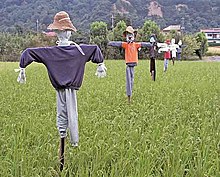
A scarecrow or hay-man is a decoy or mannequin in the shape of a human. It is usually dressed in old clothes and placed in open fields to discourage birds such as crows or sparrows from disturbing and feeding on recently cast seed and growing crops.
Sam Eagle is a Muppet character originating from the television show The Muppet Show, where he was performed by Frank Oz. Sam has appeared in every Muppet film; as himself in The Muppet Movie, The Great Muppet Caper, The Muppets Take Manhattan, Muppets from Space, and The Muppets, as well as the Head Schoolmaster in The Muppet Christmas Carol, Samuel Arrow in Muppet Treasure Island and a CIA agent in Muppets Most Wanted. He will also appear in the television series, The Muppets.

訂閱:
意見 (Atom)